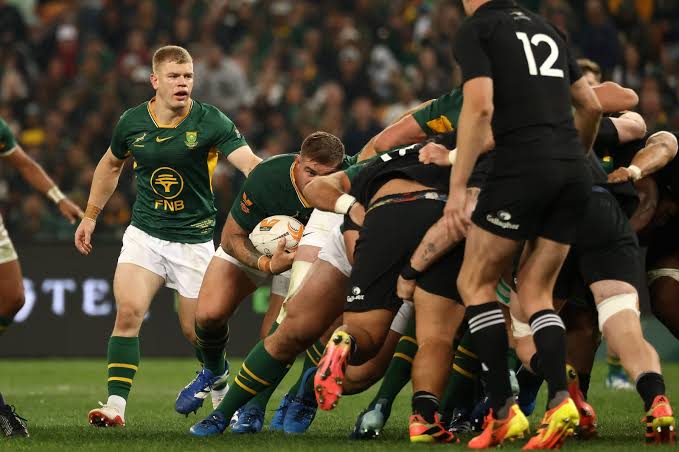
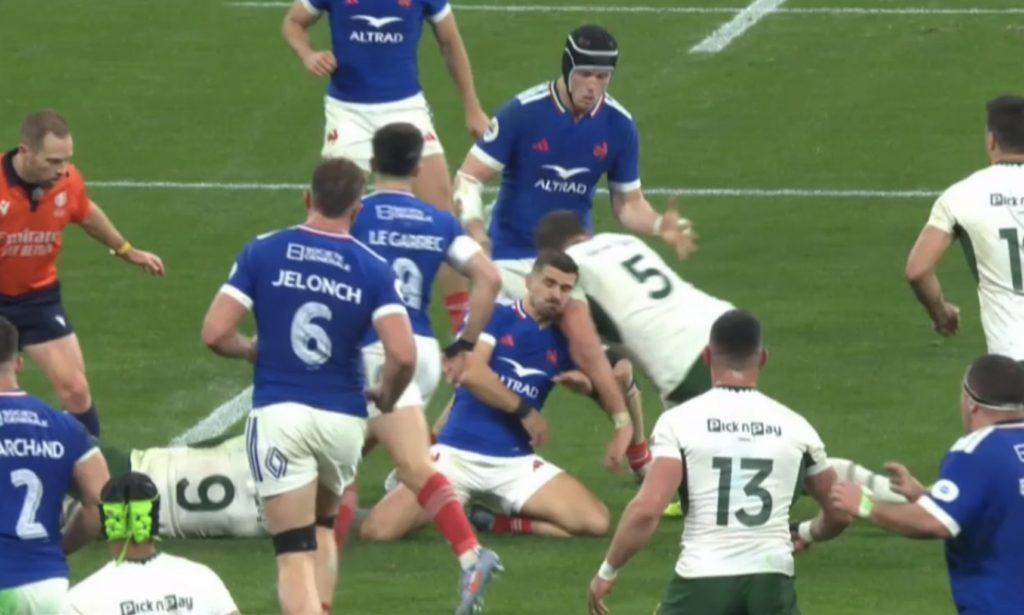
If you like your rugby tidy, consistent and ruled by the sort of logic that fits neatly into a press release, then the last week has been a slow, furious bleed of disappointment. Because in Paris, with the lights on and the cameras rolling, Lood de Jager – one of the game’s most reliable insurance policies in the second row – was controversially shown a straight red card for a shoulder-to-head collision. The decision landed like a thunderclap: controversial, immediate, and destined to start another round of “what the laws actually mean” arguments at three in the morning on Twitter.
Let’s lay the facts bare, because honesty is the only thing that makes sense when the YouTube commentators start shouting over one another. De Jager’s shoulder made contact with France full-back Thomas Ramos as Ramos was falling from a prior tackle. The TMO and match officials judged the contact to be “always illegal” – in short, De Jager did not wrap and the contact was judged intentional enough (or careless enough) to remove mitigation, ergo: permanent red. Angus Gardner issued the card after TV consultation. That sequence – tackle, review, red card – is the headline. The debate about whether it was right or wrong is the novel.
But why care? Because red cards change matches, careers and reputations. They also reveal the fault lines in world rugby: the struggle between an uncompromising head-safety regime and the messy reality of live sport. Some parts of the rugby ecosystem loved this: every time the TMO draws a line in the sand, there’s a small, righteous cheer from anyone who’s worried about concussions. Others – including quite a few voices with genuine history in the game – blinked, took their hats off, and asked if the sport had just overreached. Former Springbok greats and pundits were among the confused, and not just quietly: Schalk Burger publicly said he “couldn’t agree” with the decision, and multiple outlets flagged the call as controversial. P
Now we get to the meat of the argument. World Rugby rewired the laws to prioritise head safety — the sport did this consciously and rightly – but the red card for De Jager feels like the moment when the wiring meets a lightning storm. The law says: if your arm is tucked and the contact is to the head, mitigation is minimal; if your arm is wrapped and the head contact is incidental, mitigation can apply. In Paris, the TMO and officials said De Jager’s arm position prevented any mitigation. That’s a defensible reading of the rulebook. It is also an emotionally unsatisfying one for fans who watched a player make what they felt was a rugby-incidental collision rather than a malicious strike.
And of course – predictably, maddeningly – the commentary and social media exploded. Polls and message boards lit up: was it a correct interpretation, or a dangerous precedent? SARugbymag’s instant poll found a large portion of fans saying “no” – the overwhelming early sentiment being that De Jager didn’t deserve a red, even if the referee followed the letter of the law. That split between law and spirit is what makes this story stick to the teeth.
But let’s play devil’s advocate for a minute (it’s what we do when we aren’t losing our minds on X). The stricter head-contact framework was designed after years of tragedy and research. When you lean on that law, you signal a cultural shift: rugby would rather be a safer, slightly less theatrical sport than forever deny the human cost. Arguably, this is the right place to be. The difficulty is consistency. Fans will tolerate a hard red if it looks like a consistent standard is being applied. What fans won’t tolerate is a rule that seems to flip depending on the camera angle, the competition, or the reputation of the player involved. And right now – in the fog of immediate reaction – it feels inconsistent.
There’s a second, nastier layer: practical outcomes. De Jager’s red forced South Africa to play the second half one man short; the coaching staff had to reshuffle, the substitutions were used differently, a game plan got rewritten mid-air. In Paris the Boks still managed to dig deep and win – which, in the eyes of some, makes the red look even more puzzling (why send a man off if the team survives and looks better for it?). In the eyes of others, the resilience shown after a red is proof that the laws do not remove the drama – they create new ones. Either way, the game feels the ripple.
What’s likely to happen next? Expect a disciplinary hearing; expect pundit panels full of ex-players asking for nuance; expect World Rugby to reiterate the rule’s intent and the need for player safety. Expect, too, the predictable calls for more clarity on “mitigation” – what counts, what doesn’t, and who judges it. The De Jager card will be a case study: how an elite player’s split-second choice intersects with an evolving law and a TMO who must interpret both in 60 seconds of deliberation. The optics are messy, but the outcome – clearer protocols or a re-refined interpretation – will be useful, even if painful.
Let’s be blunt: rugby doesn’t break because a red is issued. It breaks when fans, players and administrators keep talking past each other. That’s the real danger. The De Jager moment is an opportunity to make the game safer and more consistent. Or it’s a moment to shout incoherently into voids and create more confusion. Which path we take depends on whether the governing bodies listen to the nuance, rather than the outrage.
At the ground level, we should also spare a thought for De Jager. He’s an experienced pro whose discipline record has been solid for years. Regardless of whether you think the red was correct, this moment will cost him: possible suspension, time off, ridicule and the anxiety of appeals. That human cost is the part rugby fans, especially the loud ones, should be able to balance with their moral certainty about safety.

So: did the red card “break world rugby”? Dramatically, no. Practically, it cracked a fault line. The rules are doing what they’re supposed to do – protect players – but the application, and the public’s reception of it, shows the sport still hasn’t found the equilibrium between safety and the game’s lived reality. Lood de Jager’s red is less a single bad call than a mirror held up to a sport in transition: righteous, awkward, and loudly contested.
If you want to be angry – be angry at the inconsistency. If you want to be philosophical – accept that the game is changing, and that change is loud. If you want to be kind – spare De Jager and let the process do its work. And if you’re just here for the hot takes and memes, well – at least we now have another vintage moment to argue about until the next rule tweak.