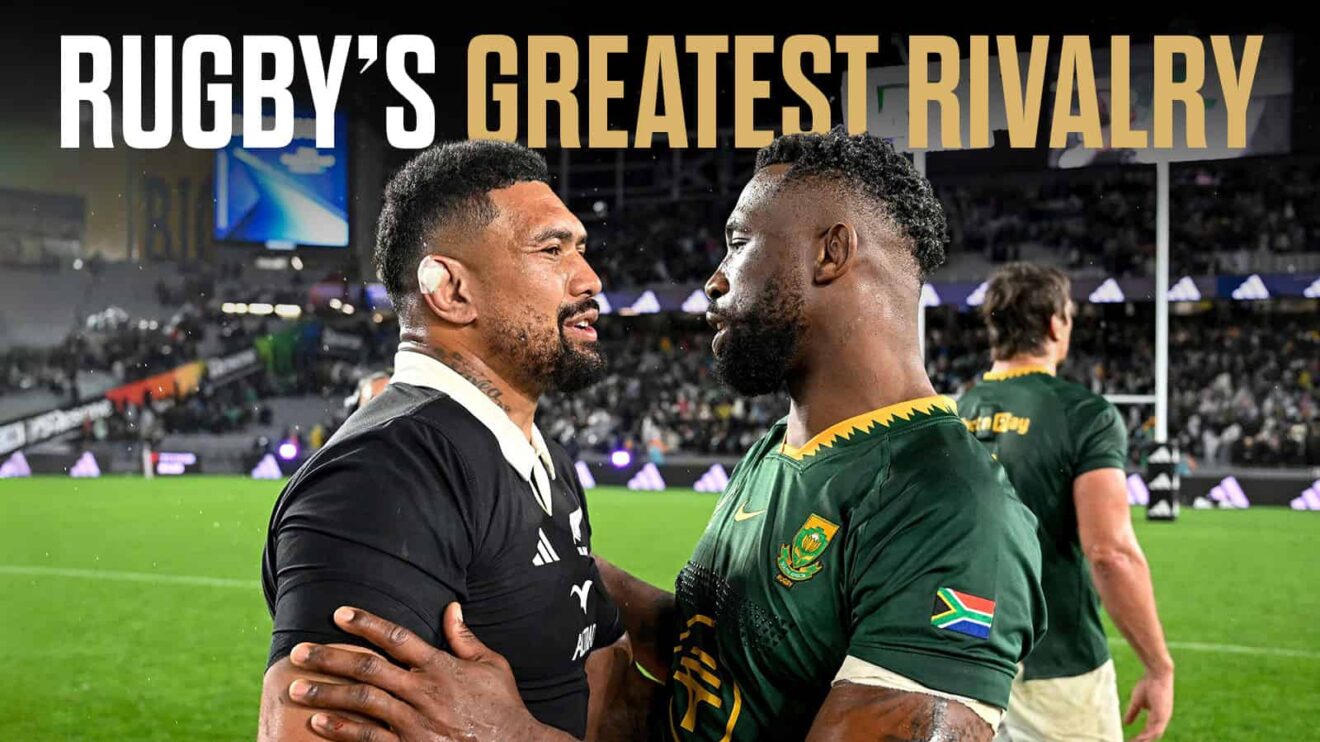
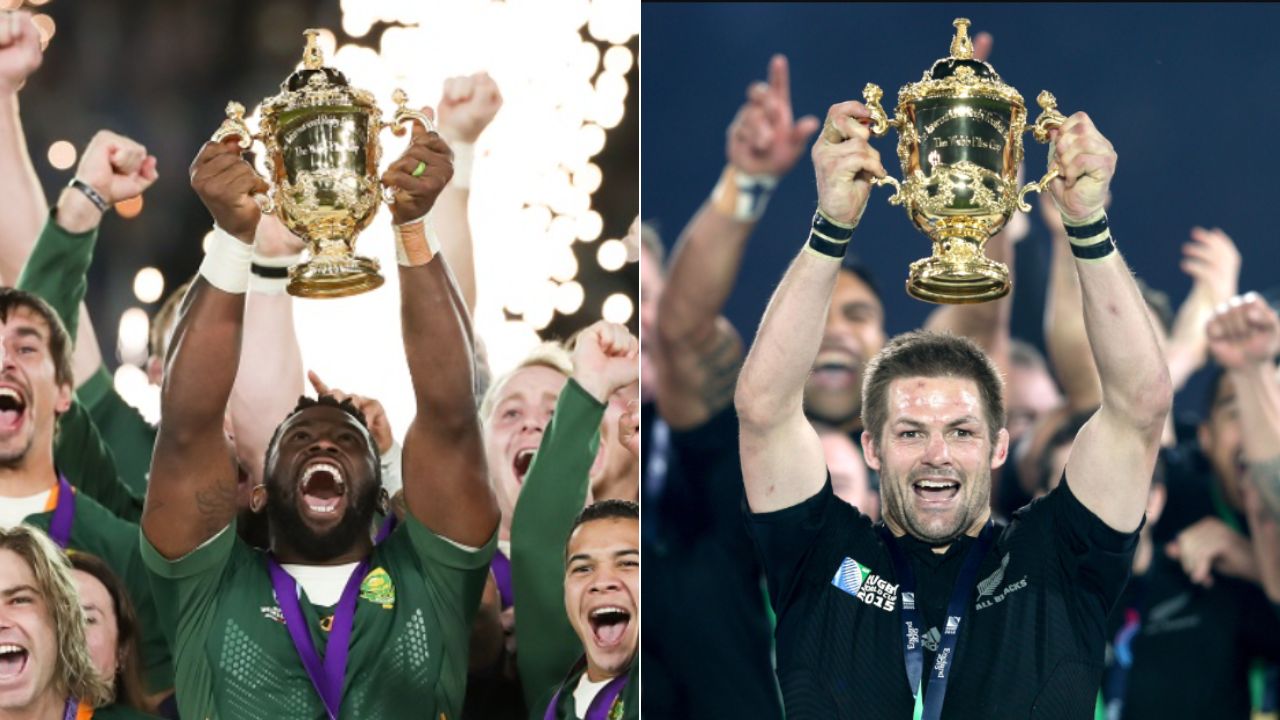
The Springboks’ emphatic victory over Ireland in Dublin did more than settle a narrative – it buried a ghost. For years, that fixture was the one lingering frontier, the last unclaimed peak of a golden era defined by resilience, reinvention, and ruthless precision. Conquering Dublin didn’t just close a chapter; it opened the way for a glorious hypothetical. If dynasties could collide across eras, what would rugby’s greatest rivalry look like if the most dominant Springbok side of the professional era toured against the most dominant All Blacks side ever assembled?
Two Tests in New Zealand.
Two Tests in South Africa.
A tour not to settle debates, but to fantasise in pure selection theorem.
What follows is the definitive breakdown – the 33-man Springbok squad (2019–2025) and the 33-man All Black squad (2011-2015), grouped with precision into props, hookers, locks, loose forwards, scrum-halves, flyhalves, centres, and outside backs. No predictions, no simulations – just the distilled question:
Who would actually be selected?

THE ALL BLACKS: 2011-2015 – THE STATISTICAL DYNASTY
Between 2011 and 2015, the All Blacks weren’t merely winning – they were redefining dominance. Win percentages shattering records, Rugby Championship dominance, and the first back-to-back Rugby World Cup titles in history. This was a machine built on leadership, precision, and ruthless consistency.
Below is the 33-man squad that best encapsulates that era, organised exactly by position group.
PROPS
Tony Woodcock, Joe Moody, Wyatt Crockett, Owen Franks, Ben Franks, Charlie Faumuina
This was an era where the All Blacks scrum evolved from solid to weaponised. Woodcock, the silent assassin of the loosehead. Franks, the technician on the tight. Moody and Faumuina providing dynamism, Crockett the athletic engine, and Ben Franks the reliable second anchor. Six specialists who could front any pack, anywhere.
HOOKERS
Dane Coles, Keven Mealamu, Codie Taylor
Mealamu the heartbeat. Coles the prototype of the modern, roaming hooker. Taylor the heir apparent. Together, they formed the spine of the most precise lineout operation in world rugby.
LOCKS
Brodie Retallick, Sam Whitelock, Luke Romano, Jeremy Thrush
Retallick and Whitelock remain the standard by which partnerships are judged – athletic, intelligent, brutal in the tight. Romano and Thrush provided continuity: reliable jumper options, maul enforcers, and tactical maul readers. Four locks, all specialists, no passengers.
LOOSE FORWARDS
Richie McCaw, Kieran Read, Jerome Kaino, Liam Messam, Sam Cane, Victor Vito
A legendary unit. McCaw the greatest openside to ever bind onto a scrum. Read the expressive No.8 with aerial dominance and link-play genius. Kaino the defensive sledgehammer. Messam the glue man. Cane the apprentice, already world-class. Vito, the athlete who gave the All Blacks explosive rotational depth. Six men who defined five years of controlled chaos.
SCRUMHALVES
Aaron Smith, TJ Perenara, Piri Weepu
Aaron Smith: the sharpest pass of the era, tempo dictation at its peak. Perenara the competitor, a heartbeat of physicality and counter-ruck presence. Piri Weepu the tactician – strong, composed, and vital in tight-clutch fixtures.
FLYHALVES
Dan Carter, Beauden Barrett
The master and the magician. Carter – the metronomic G. O. A. T. Barrett – the spark. Between them, there was no system they couldn’t run, no defensive line they couldn’t bend, no territory they couldn’t claim.
CENTRES
Ma’a Nonu, Conrad Smith, Sonny Bill Williams, Malakai Fekitoa
Nonu and Smith are often remembered as the greatest centre partnership of the professional era. Williams added dimensions few midfields could handle. Fekitoa brought pace and line-break menace. Four specialists, each capable of starting.
OUTSIDE BACKs
Ben Smith, Julian Savea, Nehe Milner-Skudder, Israel Dagg, Waisake Naholo
Power, pace, balance, and tactical intelligence. Savea the freight train. Milner-Skudder the ghost-stepper. Smith the safest pair of hands in world rugby. Dagg the Rolls Royce of positional play. Naholo the unstoppable finisher. A back three group any era would fear.
THE SPRINGBOKS: 2019-2025 – THE RENAISSANCE DYNASTY
Two World Cup titles (2019, 2023), consecutive Rugby Championship triumphs, historic wins in and out of the hemisphere, and finally the conquest of Dublin – South Africa’s golden era is defined by tactical clarity, emotional resilience, and a depth unmatched in its history.
Here is the 33-man Springbok squad, grouped exactly as required.
PROPS
Ox Nché, Steven Kitshoff, Frans Malherbe, Trevor Nyakane, Wilco Louw, Vincent Koch
A terrifying group. Malherbe and Kitshoff became the modern gold standard. Louw’s Dublin demolition will be replayed for decades. Nyakane’s versatility made the Bok scrum malleable. Nche became the first prop to be nominated for a World Rugby Men’s Player Of The Year award. Six props, all elite, all interchangeable.
HOOKERS
Malcolm Marx, Bongi Mbonambi, Deon Fourie
Marx: unstoppable. Mbonambi: battle-hardened. Fourie: the warrior who rewrote the job description at a World Cup. Three hookers – but the productivity of five.
LOCKS
Eben Etzebeth, RG Snyman, Lood de Jager, Franco Mostert, Ruan Nortje
The greatest lock group South Africa has ever produced. Etzebeth the enforcer. Snyman the aerial disruptor. De Jager the systems general. Mostert the engine. Nortje the stable technician. Five world-class tall men delivering unprecedented continuity.
LOOSE FORWARDS
Siya Kolisi, Pieter-Steph du Toit, Duane Vermeulen, Jasper Wiese, Kwagga Smith, Marco van Staden
Kolisi the leader of men. Du Toit the human eclipse. Vermeulen the professor of collisions. Wiese the hammer. Kwagga the chaos element. Van Staden the silent assassin. The Boks’ loose forwards redefined balance and tempo over seven seasons.
SCRUMHALVES
Faf de Klerk, Cobus Reinach, Grant Williams
Faf: the disruptor. Reinach: the sprinter. Williams: the injection of electric unpredictability. Three scrumhalves capable of shaping match tempo in radically different ways.
FLYHALVES
Handré Pollard, Manie Libbok, Sacha Feinberg-Mngomezulu
Pollard the iceman. Libbok the painter. Feinberg-Mngomezulu the prototype of the modern, hybrid decision-maker. Three men who together gave the Boks more tactical dimensions than any era preceding them.
CENTRES
Damian de Allende, Lukhanyo Am, Jesse Kriel, Andre Esterhuizen
Power, precision, defensive mastery, and cerebral organisation. De Allende the go-forward merchant. Am the defensive oracle. Kriel the adaptable line-runner. Esterhuizen the heavy-hitter. A perfect four-man centre group.
OUTSIDE BACKS
Cheslin Kolbe, Makazole Mapimpi, Kurt-Lee Arendse, Damian Willemse, Willie le Roux, Aphelele Fassi
Six players, all different, all dangerous. Kolbe the miracle worker. Mapimpi the story rewritten. Arendse the assassin. Willemse the universal plug-in. Le Roux the organiser. Fassi the strike weapon. Pace, skill, height, intelligence – a complete stable.
CONCLUSION: TWO DYNASTIES, NO NEED FOR A DECIDER
There is no need to script results. No hypothetical scorelines. No invented drama. The beauty of this theorem is the squads themselves. Two eras where rugby reached its highest levels of craft and chaos. Two systems that built dynasties. Two nations who understand each other better than anyone else.
A four-Test tour.
Four venues.
Two 33-man squads crafted for greatness.
Not to settle a debate.
Just to marvel at what the sport’s two greatest dynasties looked like when laid bare, position by position.
Rugby’s greatest rivalry – imagined perfectly through selection alone.