There are matches that are remembered for the scoreline, and there are matches that are remembered for the moments inside the scoreline – the needle, the chaos, the emotional flashpoints that reveal more about a team than any stat or scoreboard ever could.
South Africa’s 24-13 win over Ireland in Dublin falls squarely into the second category.
It was a night that exorcised ghosts. A night that stamped the Springbok era from 2019 to 2025 as not only dominant, but complete – the one frontier left unconquered finally falling beneath a green wave of precision, pressure, and uncompromising brutality. Ireland, so often the dragon that could not be slain, were suffocated into errors, reduced in numbers, and mentally flustered by a Springbok side that played like a machine with a heartbeat.
And yet, of all the tackles, carries, and scrums that carved the Boks’ victory, the moment that has been replayed, dissected, and ranted about more than any other is one you won’t find in the official match highlights package:
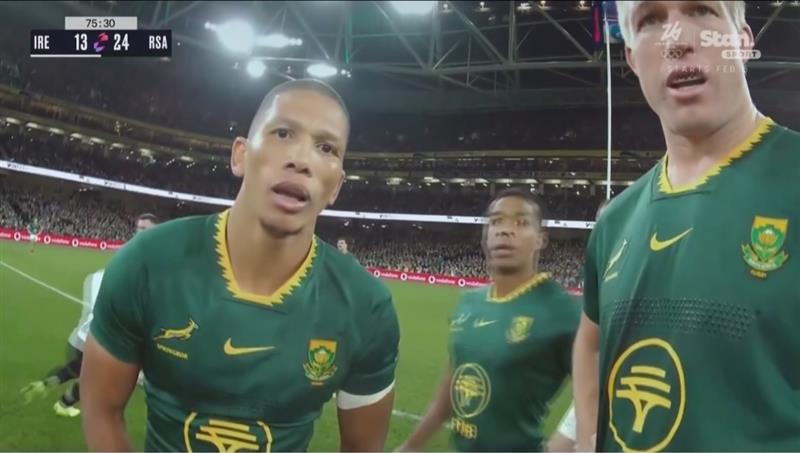
Manie Libbok celebrating an Irish knock-on… and being penalised for it.
THE CONTEXT: IRELAND IN DESPERATION MODE, THE BOKS IN CONTROL
The clock was slipping away. Ireland were chasing a game that was already drifting out of reach, heaving their final attacks at a Springbok defensive line that refused to yield. Phase after phase, tackle after tackle, Ireland tried to shake something loose. But South Africa – with the smell of a final frontier in their nostrils – were immovable.
Then came the moment.
In the chaos of a ruck near midfield, Ireland fumbled. Under pressure, under duress, under the weight of a defensive system designed to break spirits, an Irish ball-carrier knocked on. Matthew Carley, who had been working overtime in a match filled with cards, collisions, and scrummaging carnage, blew the whistle and signalled the knock-on.
Scrum: South Africa.
But before the ball could even make its way to the Bok front row, everything changed.
THE CELEBRATION – AND THE REVERSAL
Manie Libbok, who had been orchestrating the Bok attack with tactical maturity and defensive courage all night, reacted instinctively to the knock-on. He celebrated – loudly, directly, and in the face of the Irish player who had spilled the ball. In that split-second, it was emotion unfiltered. Tension released. A roar born of pressure turned into dominance.
But Carley didn’t like it.
Before the scrum could form, his arm lifted again. The TV camera zoomed. The ref mic crackled. And in a moment that sent confusion rippling across the stadium, he reversed the decision.
Instead of a Bok scrum, it was now an Irish penalty.
Unsportsmanlike conduct.
Specifically: celebrating at an opponent.
The stadium erupted – partly in shock, partly in laughter, partly in disbelief. South African players protested. Irish players shrugged. Commentators scrambled for explanations.
And suddenly, a nothing moment became the talking point.

THE LAW: WHAT CARLEY SAW AND WHY HE BLEW IT
World Rugby Law 9 deals with foul play – the broad, occasionally ambiguous world of things you “really shouldn’t do.”
Subsection 9.27 is the one Carley reached for. It covers:
“Acting contrary to good sportsmanship.”
This is the law that referees use for shoving after the whistle, mouthing off, taunting, sarcastic applause, and the classic “let me clap under your nose because you knocked on” behaviour.
Under the law, the sanction is a penalty at the mark of the original infringement.
Which is exactly what Carley delivered.
Did he have to?
No.
Was he allowed to?
Absolutely.
Was it a little soft given the stakes, the physicality, and the tone of the match?
You’d struggle to find a Springbok fan who would say otherwise.
But in the sterile language of the rulebook, the call was technically correct.
In the emotional language of rugby, it was… contentious.
WHAT THE MOMENT REVEALED ABOUT THE SPRINGBOKS
There is something deeply revealing about this incident – something more meaningful than the penalty itself.
South Africa, more than any team in the modern game, thrive on emotional ignition. Their dominance comes not just from structure, power, and systems, but from human energy – from pressure breaking opponents into decisions they don’t want to make.
This was one of those moments.
Ireland knocked on because they were rattled.
Libbok celebrated because the Boks smelled victory.
Carley reversed it because emotions crossed an invisible line.
And yet, the penalty did nothing to shift momentum.
It didn’t change the story.
It didn’t dent the outcome.
If anything, it reinforced the narrative:
South Africa were so dominant that they could give Ireland charity possession and still keep the game under control.
That’s how complete this victory was.
THE FAN REACTION: COMEDY, COMMENT WARS, AND REF WATCH DOGS
On social media, the incident exploded immediately:
- Bok fans:
“You get carded for breathing on them now?”
“Softest penalty of 2025.”
“This is rugby, not netball.” - Irish fans:
“Well within the laws.”
“If you chirp a player on the ground, that’s on you.”
“Don’t poke the bear – unless you want the ref involved.” - Neutrals:
“Entertaining chaos.”
“Penalty? Technically yes. Spiritually? Nah.”
“Refs are allergic to personality.”
The moment became a micro-battle in the endless war between letter of the law and spirit of the game — a war rugby will always fight and never win.
WHAT IT MEANS: A FOOTNOTE TO A STATEMENT WIN
This incident won’t define the match.
It won’t define the rivalry.
It won’t define Manie Libbok.
And it certainly won’t define the Springbok era.
But as a moment – a sharp, emotional, human flash in the violence of elite Test rugby – it fits perfectly into the tapestry of this golden generation.
It showed:
- their competitiveness,
- their bite,
- their psychological edge,
- and their ability to turn pressure into dominance.
In the end, Ireland’s knock-on and Libbok’s celebration were just symptoms of the same truth:
The Boks came into Dublin with a mission – and they completed it with force.
If anything, the penalty only made the win more poetic.
Because nothing says “we own this rivalry now” quite like winning by 11 – on the road – while gifting the opposition penalties out of pure, unfiltered emotion.